Most newsrooms can tell you how many stories they published last week. Fewer can describe what that output felt like to their audience. Whether the mix of tones, topics, and formats served different readers at different moments, or whether the news cycle quietly pulled everything toward sameness. That is not a publishing problem. It is a planning problem. And it is one of the more consequential blind spots in modern newsroom management.
What television worked out long ago
At a recent gathering of European publishers, Gregor Landwehr of Highberg, co-lead of Drive, a data collaborative spanning 30+ German-speaking publishers, made a point worth borrowing.
"It's not a natural law that news airs at eight in the evening," he said. "That's a deliberate product decision, repeated until it became a habit."
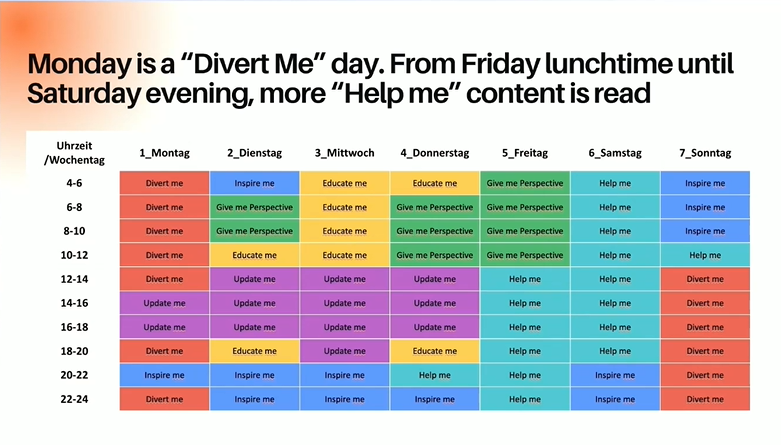
The data shows digital publishers can do the same, but only if they plan for it. Audience needs follow recognisable patterns: mornings call for depth and context; midday audiences want quick updates and practical answers; evenings shift toward stories that offer perspective or a mental break. Across the week, Mondays favour lighter content, mid-week sees stronger appetite for hard news, and Friday afternoons spike around weekend planning.
The point isn't to schedule every hour. It's to build a content pool that meets your audience at the moments that matter and to do that consistently enough that it becomes a habit they rely on.
TV schedulers have always treated balance as a product. A hard news segment, a human-interest story, then sports, this is a sequence designed to hold attention across an entire session. Digital newsrooms have the data to do the same. Most lack the planning structure to act on it.
Start measuring it
Gregor's approach is intentionally practical. You don't need to plan every hour of the day. A rough and broad editorial plan is enough to start.
- Think about what your readers expect at key moments across the day and week — morning context, midday updates, evening wind-down
- Build your content pool first — you can only plan or personalise around content that actually exists
- Don't rely only on data — combine it with your editorial experience; that's where the strategy comes from
- Use your editorial content calendar to map that pool to the right moments.
The goal is consistency. A reliable mix, repeated over time, is what turns a planned editorial approach into a habit your audience builds around.
If you can't describe the balance of your output last week — by tone, topic, format, or audience — you're managing your newsroom blind. That's fixable, and it doesn't require an overhaul. What it requires is visibility: an editorial planning layer that shows you what you're producing across time, where the gaps are, and whether your mix is actually serving your audience at the moments that matter.
That's what Kordiam is built for. Get started.