When editorial planning breaks down the problem is rarely a lack of effort. It's a lack of clarity.
This could look like fuzzy ownership, a publication date updated in one newsroom system but not another, or a platform assignment assumed but never confirmed. Each of these is a coordination failure, and if they’re not addressed, they will compound.
The scale of the challenge is only growing. According to the Reuters Institute Digital News Report 2025, six online platforms now reach more than 10% of audiences weekly with news content compared with just two a decade ago. INMA's 2025 newsroom trends report identified fragmented tools and incomplete integrations as a defining operational problem, one already resulting in missed revenue opportunities and growing technical debt.
Clarity is a structural condition, and it shows up, or fails to, in four specific areas of daily editorial planning.
1. Ownership: Who Is Doing What?
When a workflow is distributed across disconnected systems, accountability becomes diffuse. Journalists aren't sure what they're responsible for. Editors aren't sure what's been done. And when something is missed, nobody can quite explain how.
One newsroom leader described counting more than 40 tools and tabs required to publish a single story at one of their titles. “It’s what we call the unsustainable compromise,” they said. “The newsroom has to do one more thing, but at the same time you’ve got these cost-cutting pressures coming in.”
Ownership clarity means every story has a named person, a defined task, and a visible status and that information is accessible to everyone involved, in one place, in real time.
2. Priority: What Matters Most Right Now?
Editorial teams make dozens of decisions every day about what to pursue, how to frame it, and where to invest resources. Those decisions are better when they're informed, but only if the right data reaches the right people at the right moment.
The Reuters Institute report is direct on what audiences actually want: depth and original reporting over volume. Teams that consistently make better decisions about what to pursue, and why, are the ones that build lasting reader relationships. That requires performance data visible at the planning stage, not days after publication when the news cycle has moved on.
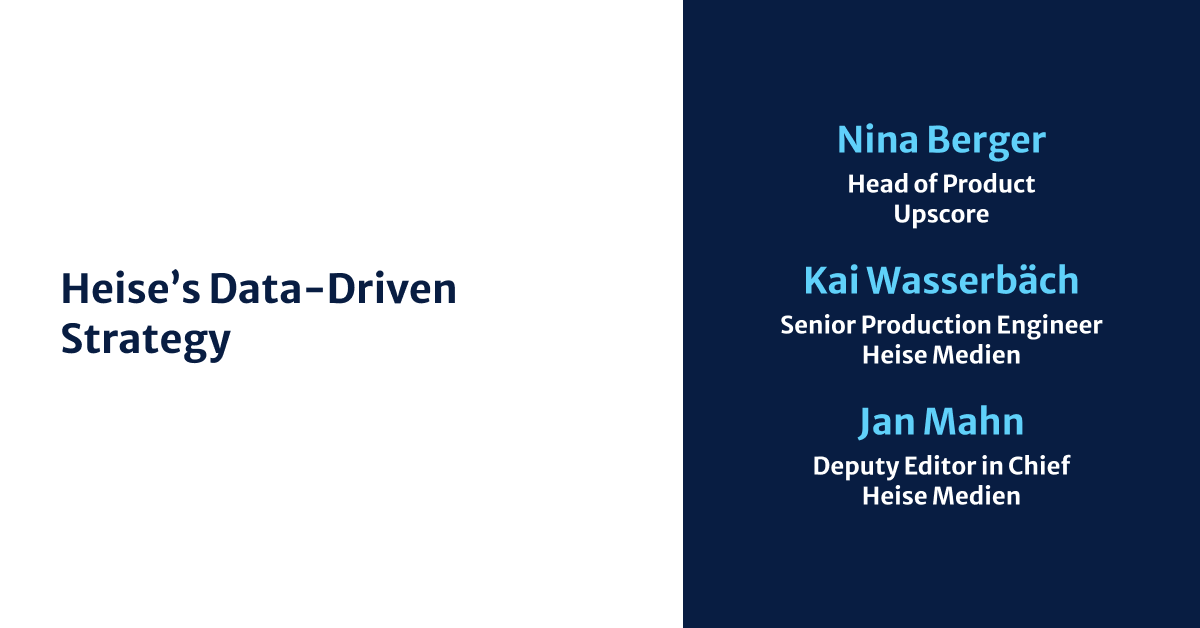
Nina Berger, Head of Product at Upscore, put it plainly at Kordiam's Editorial Days 2025, "Journalists make decisions every day, and they make a lot of decisions, what stories to publish, how to frame them, when to go live, where to go live, how to go live. These decisions benefit from data, but only if the data is accessible at the right time, at the right place. That's why we believe data should be integrated into existing workflows as seamlessly as possible."
The collaboration between Heise, Upscore, and Kordiam was built around exactly this. By integrating performance KPIs such as views or conversion data directly into the editorial planning view, editors at Heise could see which stories were resonating with readers without switching systems. Jan Mahn, Deputy Editor-in-Chief, described how his team used to operate across two separate worlds: Kordiam for planning, Upscore for analytics. Now, in the same view, they can pull up the metrics that tell them whether a topic is worth pursuing before the assignment is made.
3. Timing: When Does This Go Live?
A publication date seems like a straightforward piece of information. In practice, it has to live simultaneously across planning, production, and publishing systems. However, when those systems don't talk to each other, dates drift, schedules slip, and editors spend time chasing updates instead of making decisions.
Timing clarity goes beyond logistics. Gregor Landwehr, Associate Manger at Highberg and co-lead of the Drive digital revenue initiative, presented findings from shared data spanning 30 German-speaking publishers that showed audiences follow consistent content patterns across the day and week. Context-seeking content in the morning, lighter and diverting stories at lunchtime, more inspiring pieces in the evening. Harder news mid-week, culture and sport at weekends. "It depends on the time of the day how users are using our products," he said. "And the interesting thing is that the content differs too." His point is that you can only serve those patterns if you planned for them. The right content has to exist before the right moment arrives. Publishing the right story at the wrong time is a missed opportunity.
4. Platform: Where Does This Story Go?
A story in today’s newsroom is rarely just an article in a newspaper. It might be a website piece, a newsletter item, a column on the printed front page, a social post, a push notification. Each destination carries its own format requirements, timing considerations, and audience expectations. When platform decisions aren't captured and communicated clearly at the planning stage, they have to be reconstructed later.
Dzeni Vejsilovic, Head of Content Engineering at Glide Publishing Platform, described what changes when planning and publishing are integrated: headline, author, publication date, platform assignment, paywall status — all of it is assigned at the planning stage and then travels with the story automatically. "Almost all the fields are already populated," she said at our Editorial Days 2025. The decisions made during planning arrive intact at the point of production, with nothing lost in transit.
Clarity Is a Structural Condition
What connects all four of these dimensions is that they are addressed by giving teams a shared, single source of truth that holds information as it moves through the workflow.
When that foundation is in place, the dynamics of a fast-paced newsroom change. Decisions happen quickly because the information needed to make them is already visible. Coordination happens without friction because everyone is working from the same picture. Stories arrive at publication with the right metadata, the right platform assignments, and the right time.