
TL;DR:
Newsroom software today isn't one all-in-one platform — it's a stack of specialized tools: a planning layer (like Kordiam) for story ideas and assignments, a CMS for publishing, DAM for assets, chat tools like Slack for coordination, and distribution tools for social and newsletters. Legacy all-in-one systems struggle as workflows, contributors, and channels multiply, which is why SaaS and well-integrated modular tools have taken over.
The planning tool typically sits at the center of that stack, feeding structured data — story status, ownership, deadlines — to everything else, which is also what makes AI-driven automation useful instead of guesswork. Newsrooms that switch successfully tend to do it in phases: add a dedicated planning layer first, then connect it to the CMS and other systems step by step rather than replacing everything at once.
What is Newsroom Planning Software?
Newsroom planning software is the system editors, producers, and journalists use to plan, track, and coordinate editorial work from the first story idea to publication. It gives teams a shared overview of what is being worked on, who owns each story, and how content moves through the newsroom workflow.
At its core, newsroom planning software brings structure and visibility to editorial operations. It supports story planning, assignments, production workflows, deadlines, and collaboration across teams. The goal is to help editors understand priorities at a glance and keep newsroom activity aligned without relying on scattered tools.
For many years, newsrooms relied on large all in one systems or manual processes like spreadsheets and email threads to manage planning. These approaches were created to keep teams organized, but they often made it harder to maintain a clear and up to date overview as workflows grew more complex.
Today, newsroom planning software plays a central role in editorial operations. As newsrooms publish more frequently and teams work across locations and formats, a shared planning system is essential for maintaining clarity and control.
You'll also see this category called newsroom management software. Vendors use the term differently: some mean the planning layer described here, others mean a single platform meant to also handle writing, layout, and publishing. This guide uses "newsroom software" and "newsroom management software" interchangeably — the distinction that actually matters is covered below.
Table of Contents
Who Uses Newsroom Planning Software?
Why Is Newsroom Software Important?
Why Does Legacy Newsroom Software No Longer Work?
What Is the Role of SaaS in Newsrooms?
What Are the Components of Today's Newsroom Stack?
Why Are Planning Tools a Core Part of Newsroom Software?
Where Does the Editorial Planning Tool Fit into the Newsroom Software Stack?
What Should You Know About Integrating Newsroom Software Tools?
How Do Newsrooms Apply Integration in Real-World Workflows?
What Is the Role of AI and Automation in Newsroom Planning?
How Do You Transition Without Breaking the Newsroom?
Who Uses Newsroom Planning Software?
A newsroom's software setup serves every level of the organization:
- Editors-in-Chief: For high-level oversight and long-term strategy.
- Section Editors: For managing daily assignments and desk-specific deadlines.
- Channel managers and multi-platform teams: For turning core stories into channel-specific content.
- Freelancers: For uploading stories, photos and other content.
Why Is Newsroom Software Important?
The best newsroom software solves specific problems without creating new ones.
For editorial teams it means tools that:
- Are easy to adopt across teams
- Make planning and production more visible
- Integrate smoothly to your CMS and other systems
- Let you track content without manual work
- Can scale with your newsroom as it grows
You do not need more features. You need tools that help your team stay organized, publish on time, and avoid duplication or confusion. Most importantly, you need tools that can integrate seamlessly.
Why Does Legacy Newsroom Software No Longer Work?
Legacy systems once promised to handle every part of the editorial process. Many products still marketed today as newsroom management software follow that same one-platform model. But today they rarely deliver because Newsrooms face growing complexity.
Here's what's driving the change:
- Workflows have become more complex
- Teams rely on more contributors, both internal and external
- Expectations for software usability have increased
- All-in-one systems have failed to evolve fast enough
This has created a clear need for newsroom software that is flexible, quick to adapt, and easier to maintain.
What Is the Role of SaaS in Newsrooms?
Cloud-based tools have transformed how editorial teams work. Software-as-a-Service (SaaS) makes it easier to launch, update, and scale newsroom software without overloading internal IT teams.
The benefits of SaaS include:
- Flexibility to adapt to changing newsroom needs
- Faster implementation and regular updates
- Lower maintenance costs
- Easy access for distributed and remote teams
What Are the Components of Today's Newsroom Stack?
No single tool can do everything perfectly, which is why newsrooms are building "stacks" of specialized software. A high-functioning ecosystem typically includes:
- Content Planning and Strategy: Tools like Kordiam that manage story ideas, assignments, and the editorial calendar.
- Content Management (CMS): Systems where stories are written and published, such as WordPress or Drupal.
- Communication: Messaging platforms like Slack are used for quick coordination, questions, and updates between editors, reporters, and producers.
- Digital Asset Management (DAM): Systems that store and organize photos, videos, and graphics, like OpenText, huGO, or Cavok. The integration between Kordiam and huGO for example allows planners to move assets directly into their editorial workflow.
- Distribution & Social: Platforms that help teams prepare, schedule, and publish content to social channels and newsletters, using workflow connectors such as Zapier and other export or automation integrations.
Why Are Planning Tools a Core Part of Newsroom Software?
One of the most important categories within newsroom software is the planning tool. It is the central layer that connects strategy to execution.
Planning tools help teams pitch, assign, and track content. They show what is being worked on and what is ready to publish. It also tracks which content is going to be published on which platform.
The best editorial planning tools also provide visibility across teams and platforms. Editors can see who is working on what and where things stand. That is why more newsrooms are building their software stacks around a strong content planning foundation.
Where Does the Editorial Planning Tool Fit into the Newsroom Software Stack?
In most newsrooms, the planning tool comes first. It is used to log story ideas, assign tasks, and set deadlines. From there, content moves through editing, review, publishing, and analytics. As an editor said from Neue Zürcher Zeitung (NZZ), "If it's not in Kordiam, it doesn't happen." Read the case study here.
The editorial planning tool also acts as the coordination layer between systems. Kordiam sits at the center of the newsroom stack, giving editors and producers a shared overview of planning, assignments, and story status while staying connected to publishing, asset, and communication tools.

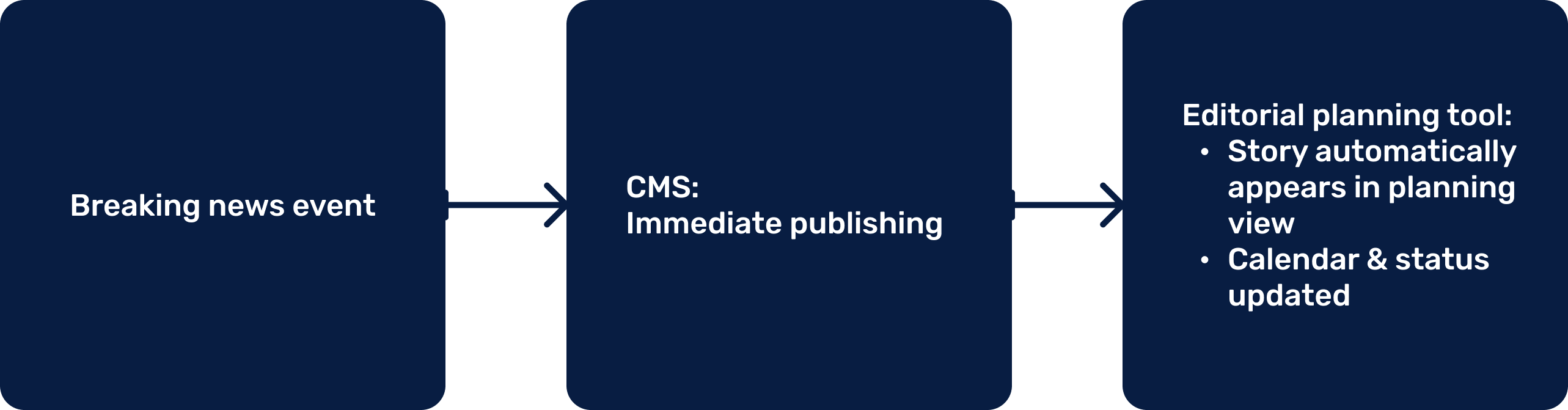
But the flow is not always linear. For breaking news, teams may skip the planning step and go straight to the CMS. In these cases, a well-integrated content planning tool can still update automatically to show what has been published. This keeps your editorial calendar complete and accurate.
What Should You Know About Integrating Newsroom Software Tools?
Not every newsroom needs deep technical integration between every tool. What matters most is workflow clarity. Before connecting systems or APIs, teams should first consider how well each tool fits into their existing editorial rhythm.
When integrating newsroom software, there are two key aspects to evaluate:
Workflow fit
This refers to how naturally a tool supports the way editorial teams already work. A strong workflow fit means the software reduces friction rather than adding new steps. For example, the Kordiam Slack integration brings assignments and status updates directly into newsroom channels, so reporters and editors stay aligned without switching tools.
Technical integration
This refers to how systems exchange data behind the scenes. In some setups, tighter technical integration is useful, especially between planning tools and the CMS. For example, CMS integrations used by teams at Der Standard, Aptoma's DrPublish or on the Glide Publishing Platform allow story data to move from pitch to publish with minimal manual input.
In other cases, a lighter integration is sufficient. For example, a one directional integration with analytics tools like Upscore allows performance data to inform the newsroom planning, without adding complexity to existing workflows.
How Do Newsrooms Apply Integration in Real-World Workflows?
The purpose of integration is not technical complexity. It is to reduce duplication, prevent inconsistencies, and ensure that story status, ownership, and timing stay aligned across systems. When integration adds clarity without adding friction, it strengthens the entire newsroom workflow.
Here is how news organizations apply this in practice.
- Connected Editorial Workflows: Before integration, editorial planning, digital publishing, and print production were handled in separate systems at many newsrooms. Editors had to enter the same information multiple times, and updates in one system were not reliably reflected in the others. This increased coordination effort and made it harder to maintain a clear overview. At Madsack the jambit team solved this problem by integrating Kordiam with Arc XP and EidosMedia, bringing editorial planning, digital publishing, and print systems into sync. This eliminated duplicated data entry, ensured updates flow across systems, and restored editorial focus to the work that matters.
Read the whole article "Integrating the New and Old World with Kordiam, Arc XP and EidosMedia". - Digital-first production without tool switching: In digital-first newsrooms, stories are developed, edited, and published continuously. When pitching, editing, and publishing happen in separate systems, journalists are forced to jump between tools, which slows production and breaks momentum. At Der Standard and publishers using Glide Publishing Platform the CMS integration was designed to support this digital-first reality. Story ideas are planned where they are published, and editorial decisions flow directly into the CMS. This allows teams to move from pitch to published without manual transfers, supporting fast iteration and continuous publishing rather than fixed production cycles.
Learn more about the flexible workflow at Der Standard. - Planning and Publishing in Sync: At a public broadcaster, editorial planning and publishing decisions initially lived in separate systems. Editors lacked a shared view of what was planned versus what was scheduled, leading to manual checks and coordination overhead. The Drupal integration with Kordiam started with a basic setup focused on keeping planning and publishing aligned. Over time, it was expanded to sync story updates, statuses, and scheduling information across systems. This gradual approach reduced manual work while giving editors clearer visibility into what is planned and what is ready to publish.
You can read the whole case study "How One Public Broadcaster Streamlined Publishing with a Drupal Integration" here. - The Slack-First Newsroom: In Slack-first newsrooms, key editorial decisions often happen in chat. Without integration, assignments and status changes risk being lost in message threads or require follow-up in separate tools. With the Kordiam–Slack integration, assignments and status updates are pushed directly into newsroom channels where reporters already work. This keeps communication and execution connected, reduces follow-up messages, and helps teams act on editorial decisions in real time.
What Is the Role of AI and Automation in Newsroom Planning?
As AI becomes more common in journalism, the focus is shifting away from content generation and toward operational support. Newsrooms are looking for ways to reduce repetitive coordination work such as tracking story statuses, monitoring deadlines, and keeping teams aligned across tools. At the same time, there is broad agreement that editorial judgment and responsibility must remain human.
Both AI Strategist Lukas Görög and Prof. Dr. Wiebke Loosen from the Leibniz Institute for Media Research, describe AI as most valuable when it supports newsroom routines rather than replaces journalistic work. Görög highlights the potential of AI to streamline workflows and save time when it is embedded in everyday systems. Loosen points out that automation is part of a broader change in newsroom practices, where routine tasks can be reduced so journalists can focus on editorial decision-making and reporting.
For this kind of operational AI to work, it depends on structured and reliable data. Many newsrooms still rely on emails, chat messages, or spreadsheets to manage planning decisions. These formats are difficult to automate because they do not provide consistent, machine-readable signals about status, ownership, timing, or publishing intent.
This is where the planning layer becomes essential. By capturing editorial decisions as structured data, planning systems create the foundation that automation can build on. Kordiam serves as this central source of truth. It is not positioned as an AI tool itself, but as the structured environment that enables AI-driven automation through its API. This allows newsrooms to reduce manual coordination work while keeping full editorial control with journalists and editors.
How Do You Transition Without Breaking the Newsroom?
Introducing new newsroom software often raises concerns about disrupting the daily news cycle. Editors and newsroom leaders need systems that improve coordination without adding risk or complexity.
A phased, modular approach helps manage this transition. Many newsrooms begin by introducing a dedicated planning layer alongside their existing CMS. This creates immediate clarity around priorities, responsibilities, and timelines while leaving publishing workflows untouched.
From there, teams can move forward step by step. Common next steps include connecting planning data to an existing CMS, aligning digital and print workflows, or introducing targeted automation where manual coordination creates the most friction. Each step builds on the last, allowing teams to adapt at their own pace.
For newsroom leaders evaluating their own setup, the starting point is the same for most teams: identify where planning decisions live today, where information gets duplicated, and where handoffs break down. From there, it becomes easier to see which parts of the workflow can be streamlined first and which changes can wait.
To explore how other newsrooms have approached this transition, you can read customer case stories on the Kordiam blog.